

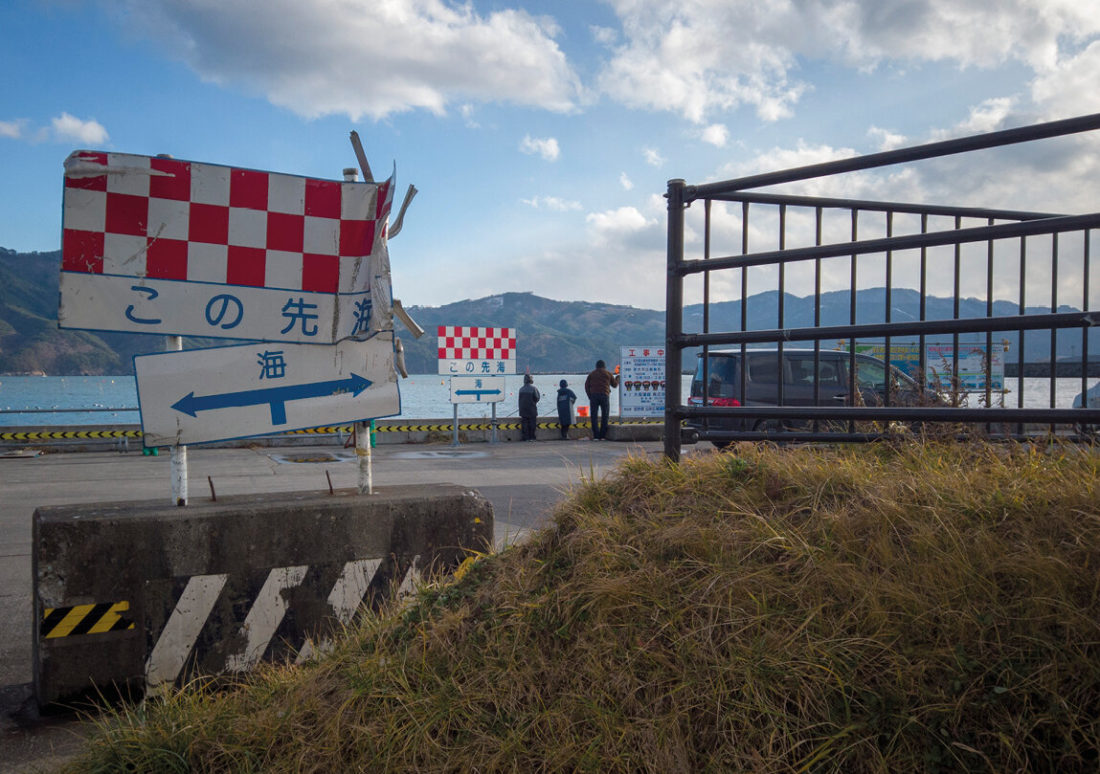
11 March 2021 marks ten years since a tsunami devastated the North-eastern coast of Tohoku, Japan. Not only was it the most photographically documented disaster in history but it is still regularly revisited in movies, television, books and photographs. Perform an internet image search today for any coastal city in Iwate prefecture (e.g. Ofunato), and the results continue to return images of destruction. When the Tokyo 2020 Olympic committee decreed that the Olympics would also be known as the “Recovery Games and Reconstruction Games”, the message in the official guidebook was explicitly clear: “Why not take a trip to the disaster-affected areas and see for yourself how the recovery and reconstruction is progressing?”
Interested in what visitors should be seeing, several trips were made to the Iwate coast to rephotograph images made during the aftermath. These trips were part of a study funded by the Japan Society for the Promotion of Science (JSPS) that was exploring temporality in a range of photomedia. Having produced a series of “new” baseline photographs during those trips, participants would be invited to revisit them during on-site workshops while the Olympic and Paralympic games were taking place. That was before the games were postponed, and the research “paused”.
Today, both the delay and the travel restrictions put in place to prevent the spread of Covid-19 have afforded opportunities to further reflect on how Iwate’s coastal cities were meant to be viewed. This presentation therefore follows this body of work through a series of eleven rephotography “textbooks”, made from a diverse range of visual material gathered during time spent in each city. These books provide walkable routes that participants can re-trace visually with no text or maps, using only rephotographic skills to situate themselves geographically and temporally within the landscape. Specifically concerning four books of Kamaishi city visited in November 2019, February 2020, March 2020 and July 2020 (via Google Street View), the hope is to foster discussion about poly-temporal practices of embracing uncertainty visually.
Read presenters' biography